By the Dar Ul Ayesha recruitment desk · Last reviewed: 26 November 2026 · Checked against MOHRE, u.ae and BEOE sources
Quick answer
To legally hire a Pakistani worker for the UAE in 2026, a MOHRE-registered UAE employer must obtain a MOHRE work permit and an entry permit from ICP (or GDRFA in Dubai). In Pakistan, a BEOE-licensed overseas employment promoter (OEP) processes your attested demand letter and power of attorney, and the worker registers with the Protector of Emigrants before flying. After arrival, you arrange the medical test, health insurance, Emirates ID and residence visa, then pay wages through the Wage Protection System by the 1st of each month. UAE law puts recruitment and visa costs on the employer, and hiring without a permit carries fines of AED 100,000 to AED 1 million.
If you run a UAE contracting, logistics or facilities business and want electricians, drivers or masons from Pakistan, you’re working with two legal systems at once. UAE labor laws (officially spelt “labour”) decide who may sponsor a worker, what the contract must contain and how wages are paid. Pakistan’s emigration laws decide who may recruit the worker, what the worker may be charged and how they leave the country.
Most guides cover only the UAE side. That gap is where hiring stalls. A visa issued in Dubai doesn’t help if your worker is held at Islamabad airport because the demand letter was never attested or the Protector stamp is missing. This guide follows both sides in the order the work actually happens, with the 2024 to 2026 rule changes, current fees and the penalties that apply.
What changed in UAE labor laws between 2024 and 2026?
The core statute is still Federal Decree-Law No. 33 of 2021 on the regulation of employment relationships. What changed is enforcement: higher fines, faster dispute decisions and a strict salary deadline. These are the updates that matter most when you recruit from Pakistan.
| Change | In force | What it means for your hiring |
|---|---|---|
| Federal Decree-Law No. 9 of 2024 (amended Article 60) | August 2024 | Fines for employing a worker without a permit, recruiting a worker and not providing work, or misusing work permits rose to AED 100,000 to AED 1,000,000 (previously AED 50,000 to AED 200,000). Fictitious employment fines multiply by the number of workers involved. |
| Federal Decree-Law No. 9 of 2024 (amended Article 54) | August 2024 | MOHRE can issue binding decisions in disputes worth up to AED 50,000. Labour claims face a two-year limitation period. |
| Nationwide mandatory health insurance | 1 January 2025 | Employers must buy health insurance before a residence permit is issued or renewed. This now applies in all seven emirates, including Sharjah, Ajman, Umm Al Quwain, Ras Al Khaimah and Fujairah. |
| Ministerial Resolution No. 340 of 2026 (Wage Protection System) | 1 June 2026 | The previous month’s wages are due on the 1st of each Gregorian month. It replaces Resolution 598 of 2022, removes the old 15-day grace period and requires at least 85% of wages to clear through WPS. |
| Pakistan and UAE pre-immigration clearance | Agreed 13 January 2026 (Karachi pilot) | UAE immigration checks are to be completed in Pakistan before departure. Confirm whether it is live on your worker’s route before you book flights. |
| Pakistan’s National Emigration and Welfare Policy 2026 | Approved 2026 | Sets the direction toward an employer-paid recruitment model and tighter rules for OEPs. Several measures still need rule changes before they become law. |
You may read that unlimited contracts were abolished “in 2026”. They weren’t. Decree-Law 33 of 2021 moved the private sector to fixed-term contracts when it took effect in February 2022, and the conversion deadline passed at the end of 2023. If any of your contracts still say “unlimited”, correct them, but don’t plan around it as a new rule.
Which laws apply when you hire a Pakistani worker for the UAE?
Three bodies of law can apply to a single hire. Knowing which one governs each step saves you from fixing the wrong problem.
| Side | Main law | Regulator | What it controls |
|---|---|---|---|
| UAE private sector | Federal Decree-Law No. 33 of 2021, Cabinet Resolution No. 1 of 2022 (executive regulations), MOHRE ministerial resolutions | MOHRE; ICP, or GDRFA in Dubai, for entry and residency | Work permits, contracts, wages, hours, leave, termination, gratuity |
| UAE domestic workers | Federal Decree-Law No. 9 of 2022 | MOHRE and licensed Tadbeer centres | Workers employed by households, such as housemaids and family drivers |
| Pakistan | Emigration Ordinance 1979 and Emigration Rules 1979 (updated 2023) | Bureau of Emigration and Overseas Employment (BEOE), Protector of Emigrants offices, OEC | OEP licensing, demand permission, worker registration, fee limits, complaints |
If your company sits in a free zone, the free zone authority handles parts of the visa process, and its own employment regulations sit alongside the federal law. Confirm the exact sequence with your free zone before you start. This guide follows the mainland MOHRE route, which covers most construction, transport and facilities employers.
Who can sponsor a Pakistani worker in the UAE?
Only an establishment registered with MOHRE can sponsor a private-sector worker, and MOHRE issues permits based on the nature of the job. Before you spend money on recruitment in Pakistan, check these five points:
- A valid trade licence that covers the activity the worker will do. A cleaning licence won’t support a steel fixer.
- A clean MOHRE record. Under Ministerial Resolution No. 543 of 2022, MOHRE can refuse new permits to establishments with certain violations.
- WPS compliance. Under Resolution 340 of 2026, late or partial salary payments trigger staged measures that can freeze new work permits.
- Your MOHRE classification. Categories A, B and C affect permit fees. Category C applies to companies with a history of violations.
- Emiratisation status, if it applies to you. Since 1 July 2026, establishments that haven’t raised Emirati salaries to the AED 6,000 minimum can have new work permits suspended.
One rule has no exceptions: a visit visa is not a work visa. Working in the UAE without a valid MOHRE permit is illegal, and employing an unauthorised worker falls into the AED 100,000 to AED 1 million fine band.
How do you legally hire Pakistani workers for the UAE, step by step?
The order matters. Steps 2 to 4 and step 7 happen in Pakistan. Steps 5, 6, 8 and 9 happen in the UAE. A good OEP runs the Pakistan side in parallel while you prepare the permits, so neither side waits on the other.
| Step | Who acts | Where | Output |
|---|---|---|---|
| 1. Define the role | Employer | UAE | Job title, MOHRE occupation, salary package |
| 2. Attest demand letter and power of attorney | Employer and OEP | UAE mission / Pakistan | Attested demand |
| 3. Protector grants permission | OEP and Protector of Emigrants | Pakistan | Permission to process the demand |
| 4. Select, test and check documents | OEP and employer | Pakistan | Shortlist with trade test results |
| 5. Job offer and MOHRE work permit | Employer | UAE | Approved work permit |
| 6. Entry permit | Employer | UAE | Entry visa for travel |
| 7. Protector registration and departure | Worker and OEP | Pakistan | Protector stamp, insurance, briefing |
| 8. Medical, insurance, Emirates ID, residence visa, contract | Employer and worker | UAE | Legal residence and MOHRE contract |
| 9. Payroll on WPS | Employer | UAE | Wages paid by the 1st |
Step 1: Define the role exactly as MOHRE will register it
Write down the job title, the MOHRE occupation, basic salary, allowances, working hours, accommodation, transport and contract length before you approach anyone in Pakistan. The job title on your offer must match the work permit and the work the person actually does. A mismatch is a common reason files get questioned later. For skilled roles, decide what proof of skill you need: a trade test, certificates, or both.
Step 2: Appoint a BEOE-licensed OEP and attest your demand letter and power of attorney
Under BEOE procedure, a foreign private employer’s demand must reach the Protector of Emigrants through a licensed OEP. The OEP must hold your power of attorney and a manpower demand letter attested by the Pakistan Embassy, the Ministry of Foreign Affairs of the employer’s country, or that country’s embassy in Pakistan. In the UAE, attestation usually runs through the Community Welfare Attachés at the Pakistan Embassy in Abu Dhabi and the Consulate General in Dubai, and BEOE operates an online Demand Attestation System that links the CWA, the OEP and the Protector.
Your demand letter should state each trade, the number of workers, salary, working hours, overtime, food or food allowance, accommodation, transport, air tickets, insurance and contract duration. Vague terms slow the Protector’s review, because the Protector must be satisfied that the wages and conditions are reasonable.
Step 3: Permission from the Protector of Emigrants
Once the Protector approves the demand, the OEP can legally start recruiting against it. Until that permission exists, any Pakistani agent “collecting CVs” for your project is working outside the system. Ask your OEP for a copy of the permission letter for your file.
Step 4: Selection, trade testing and document checks
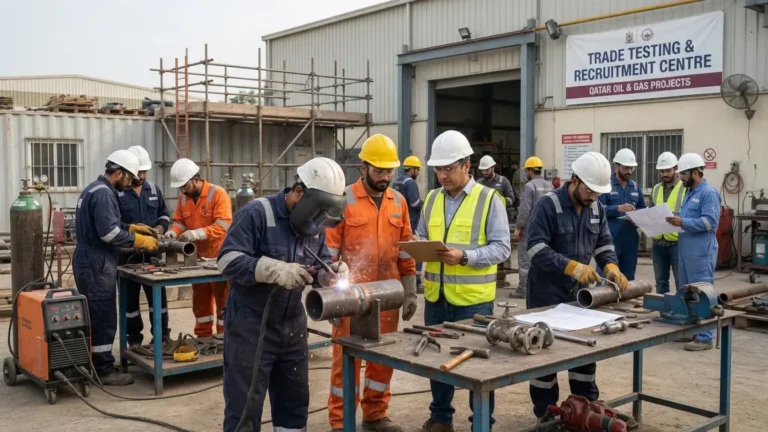
This is where you protect yourself from poor hires. Interview shortlisted candidates (online or in person), run practical trade tests for skilled roles, check passport validity and verify certificates. If a role needs attested qualifications, start attestation early, since it often takes longer than the permit itself. Dar Ul Ayesha runs trade testing at its Rawalpindi centre through NAVTTC-registered trade testing, so you can see results before you commit to a visa.
Step 5: Issue the MOHRE job offer and apply for the work permit
You apply through MOHRE’s channels, logging in with UAE Pass. The UAE’s Work Bundle platform now combines work permits, residency and the medical and fingerprint steps for Emirates ID, and the government says it cut the process from 15 steps to 5. A signed job offer must accompany the application. Permit issuance or renewal costs AED 250 to AED 3,450, depending on your company classification.
MOHRE job offers and contracts are in Arabic and English, and a third language can be added. For Pakistani workers, give them an Urdu explanation of the offer before they sign. It reduces disputes, and it supports the Protector’s check that the worker understands the Foreign Service Agreement.
Step 6: Get the entry permit
After MOHRE approval, the entry permit is issued by the Federal Authority for Identity, Citizenship, Customs and Port Security (ICP), or by GDRFA for Dubai-sponsored workers. The permit is valid only for a limited window, so check the validity date and coordinate it with the worker’s Protector appointment in Pakistan.
Step 7: Protector registration and departure from Pakistan
Every Pakistani leaving on an employment visa needs emigration clearance. The worker registers at a Protectorate of Emigrants office with the visa, passport, CNIC, signed employment contract (the Foreign Service Agreement) and a State Life insurance certificate. After a short briefing, the Protector stamps the passport. The countersigned Foreign Service Agreement is the document Pakistani authorities will use if a dispute arises, so its terms must match your MOHRE offer.
Without this clearance, workers can be offloaded at the airport. It’s the most avoidable cause of lost tickets and missed start dates.
Step 8: Medical test, health insurance, Emirates ID, residence visa and contract
After the worker enters the UAE, they take the medical fitness test and give biometrics for the Emirates ID. You buy health insurance, which has been a prerequisite for issuing a residence permit in every emirate since 1 January 2025. The residence visa is then issued, and the employment contract is finalised in MOHRE’s system. The UAE medical screens for communicable diseases, and certain results lead to residency refusal, so many employers ask their OEP for a pre-departure health check to reduce the risk of a wasted visa.
Step 9: Put the worker on WPS from the first payroll
Under Ministerial Resolution No. 340 of 2026, wages for each month are due on the 1st of the following Gregorian month and must be paid through WPS or another MOHRE-approved channel. May wages, for example, were due on 1 June. Build this into your payroll calendar before the worker lands.
How long does it take to hire a worker from Pakistan for the UAE?
MOHRE says applications for work permits for workers outside the UAE are decided within two weeks at most. The full timeline is longer, because it also depends on demand attestation, the Protector’s permission, selection and trade testing in Pakistan, flight dates and residency steps after arrival. Plan in weeks, not days, and treat any agency that promises a fixed date before your demand is attested with caution.
Three things shorten the process more than anything else: a complete demand letter on day one, a job title that matches MOHRE’s occupation list, and candidates who’ve already passed a trade test.
Who pays recruitment and visa costs for Pakistani workers?
Under Article 6 of Decree-Law 33 of 2021, the employer bears recruitment and employment costs. MOHRE has confirmed this covers hiring, travel, visa issuance, medical examinations and the residency permit. You can’t deduct these from the worker’s salary, directly or indirectly.
| Cost | Who pays under UAE law | Notes |
|---|---|---|
| MOHRE work permit | Employer | AED 250 to AED 3,450 depending on classification |
| Entry permit, residence visa, Emirates ID | Employer | Fees vary by emirate and visa duration |
| Medical fitness test | Employer | Standard or express service |
| Health insurance | Employer | Required for the residence permit in all emirates since 2025 |
| Air ticket to the UAE | Employer | Include it in the demand letter |
| Recruitment agency fees | Employer | Agree the OEP’s employer-side fee in writing |
| Pakistani emigration charges | Worker at the Protector, under Pakistani rules | See the next table; many employers reimburse them |
On the Pakistan side, BEOE sets the charges a worker pays at the Protector. These were the published amounts as of September 2026:
| Component | Through a licensed OEP | Direct employment |
|---|---|---|
| OEP service charge | Rs 15,000 (Rs 6,000 for processing-only cases) | None |
| Welfare fund (Overseas Pakistanis Foundation) | Rs 4,000 | Rs 4,000 |
| State Life insurance premium | Rs 2,500 | Rs 2,500 |
| Registration fee | Rs 500 | Rs 2,500 |
| OEC fee | Rs 200 | Rs 200 |
| Total | Rs 22,200 | Rs 9,200 |
Rule 15 of the Emigration Rules caps the OEP service charge. Anything a Pakistani agent collects above it is illegal, and BEOE tells workers to insist on a receipt for every payment. Here’s our view: the cleanest model for UAE employers is to cover the full cost, including these Pakistani charges. Nothing then conflicts with the UAE’s ban on charging workers, and it matches the employer-paid direction in Pakistan’s 2026 emigration policy.
What must a UAE employer provide once the worker starts?
These are the obligations MOHRE inspectors and labour claims focus on most. They apply to Pakistani workers exactly as they do to every other private-sector employee.
| Obligation | What UAE labour law requires |
|---|---|
| Contract | Written, fixed-term, registered with MOHRE, with terms matching the job offer |
| Working hours | Maximum 8 hours a day and 48 a week; reduced by two hours a day during Ramadan |
| Overtime | Normal wage plus at least 25%; at least 50% for overtime between 10 pm and 4 am |
| Weekly rest | At least one paid rest day a week |
| Annual leave | 30 days a year after one year of service; 2 days a month after six months |
| Sick leave | Up to 90 days a year after probation: 15 days full pay, 30 days half pay, 45 days unpaid |
| Wages | Through WPS, due by the 1st of the following month (Resolution 340 of 2026) |
| Identity documents | Employers may not keep a worker’s passport or other identity documents |
| Recruitment costs | Borne by the employer; not recoverable from wages |
| Probation | Maximum six months; an employer ending employment during probation must give 14 days’ written notice |
| Notice period | 30 to 90 days, as set in the contract |
| End-of-service gratuity | After one year: 21 days’ basic wage per year for the first five years, 30 days per year after that, capped at two years’ wages; paid within 14 days of the contract ending |
| Summer midday break | MOHRE’s annual ban on outdoor work in the midday heat (in recent years 12:30 pm to 3:00 pm, 15 June to 15 September) |
| Health insurance | Employer-paid cover in place before residency is issued or renewed |
A quick gratuity example: a steel fixer on a basic wage of AED 1,500 who leaves after three years is owed AED 1,500 ÷ 30 × 21 × 3 = AED 3,150. Gratuity is calculated on basic wage only, so keep the basic and allowance split in the MOHRE contract accurate.
What are the penalties for breaking UAE labor laws?
Since the 2024 amendment to Article 60, the fines are high enough to threaten a small contractor’s business. The UAE government’s announcement listed these offences at AED 100,000 to AED 1 million:
| Violation | Penalty |
|---|---|
| Employing a worker without a work permit | AED 100,000 to AED 1,000,000 |
| Bringing a worker to the UAE and not providing work | AED 100,000 to AED 1,000,000 |
| Misusing work permits | AED 100,000 to AED 1,000,000 |
| Closing a business without settling workers’ dues | AED 100,000 to AED 1,000,000 |
| Employing juveniles in breach of the law | AED 100,000 to AED 1,000,000 |
| Fictitious employment | AED 100,000 to AED 1,000,000, multiplied by the number of workers |
| Late or partial salary payment under WPS | Staged measures after the due date, including suspension of new work permits |
| Unpaid claims up to AED 50,000 | Binding MOHRE decision, enforceable without a full court case |
Pakistan has its own consequences. Recruiting without a licence, overcharging workers and fraudulent emigration are criminal offences under the Emigration Ordinance 1979, and BEOE publishes a list of blacklisted foreign employers. Being on that list blocks your future demands from being processed.
Eight compliance mistakes that delay or block hiring
- Bringing workers on visit visas with a plan to “convert” them later. It exposes you to the unauthorised-employment fine.
- Using an unlicensed sub-agent in Pakistan. Check every agent against BEOE’s list of licensed OEPs.
- Sending a demand letter without attestation. The Protector can’t grant permission without it.
- Letting the job title drift. The offer, permit, contract and actual duties must match.
- Deducting visa, ticket or medical costs from salary. UAE law puts these on the employer.
- Paying in the middle of the month. Since 1 June 2026, anything after the 1st counts as a delayed payment.
- Holding passports “for safekeeping”. Employers may not keep workers’ identity documents.
- Promising one salary on WhatsApp and another in the contract. The Protector countersigns the Foreign Service Agreement, and that document is what the worker can enforce.
Are UAE work visas open to Pakistani workers in 2026?
Officially, yes. In late November 2025, a Pakistani official told a Senate committee that the UAE had largely halted regular visit and work visas for Pakistanis, but the UAE Consul General in Karachi and the UAE Embassy in Islamabad publicly denied any blanket ban. Employment visas remain available, though approvals for some categories have become slower and more selective.
The numbers show the shift. BEOE registered 229,894 Pakistanis for UAE jobs in 2023, then 64,130 in 2024 and 52,664 in 2025, with 51,246 registered from January to August 2026. On 13 January 2026, Pakistan and the UAE agreed to a pre-immigration clearance system, starting with a Karachi pilot, so that immigration checks happen in Pakistan before departure. In September 2026, BEOE advised Pakistanis working in or travelling to the UAE to follow local laws closely and stay aware of their rights.
For employers, the practical response is simple: recruit for clearly defined skilled roles, submit complete attested documents, avoid the visit-visa route entirely, and confirm current processing times with your typing centre or ICP before you promise a client a start date.
How do you check that a Pakistani recruitment agency is licensed?
- Ask for the OEP licence number. Pakistani licences follow a format such as OP&HRD/5147/RWP/2024.
- Search for it in BEOE’s list of licensed OEPs and confirm the name and office address match.
- Check that the licence is current, not expired or suspended.
- Ask how the agency will route your demand through the Community Welfare Attaché and the Protector of Emigrants.
- Ask for an itemised statement of everything the worker will pay, with receipts issued for each payment.
- Review BEOE’s complaints and OEP performance pages before you sign a power of attorney.
How Dar Ul Ayesha helps UAE employers hire from Pakistan
Dar Ul Ayesha is a government-licensed overseas employment promoter in Rawalpindi, operating under the Emigration Ordinance 1979 with licence OP&HRD/5147/RWP/2024. The team has worked in recruitment since 2008 and supplies workers to employers in six GCC countries, including the UAE.
For UAE employers, we handle the Pakistan side end to end: manpower recruitment and shortlisting, practical trade testing, visa and documentation support, legal emigration processing (demand permission, contract verification and Protector registration) and pre-departure briefings on UAE law and workplace rules. We recruit across construction, electrical, mechanical, transport, housing and healthcare, from construction workers from Pakistan to electricians and drivers and logistics staff.
See how the full process works on our page for recruitment from Pakistan to the UAE, or check our licence details on the About page.
Planning to hire from Pakistan?
Send us the trades, headcount, salary and start date. We’ll tell you what your demand letter needs, how attestation will run and what the Pakistan side involves.
Frequently asked questions
Can a UAE company hire a Pakistani worker without a Pakistani agency?
Yes, through direct employment. The worker registers with the Protector of Emigrants as a direct-hire emigrant, using a contract or appointment letter attested by the Pakistan mission in the UAE, and pays Rs 9,200 instead of Rs 22,200. For group hiring against a demand letter, the law requires a BEOE-licensed OEP.
Does the employer have to pay the recruitment fees?
Yes. Article 6 of Federal Decree-Law No. 33 of 2021 puts recruitment and employment costs on the employer, including visa, travel, medical and residency costs. You can’t recover them from the worker’s wages.
Is there a minimum salary for Pakistani workers in the UAE?
The UAE has no general minimum wage for expatriate private-sector workers. The AED 6,000 minimum introduced in 2026 applies to Emirati citizens. In Pakistan, the Protector of Emigrants checks that the wages and terms in your demand are reasonable before granting permission.
When must salaries be paid under UAE labour law in 2026?
Since 1 June 2026, Ministerial Resolution No. 340 of 2026 makes the previous month’s wages due on the 1st of each Gregorian month, paid through the Wage Protection System. A payment after that date counts as delayed.
Can I employ a Pakistani worker who is already in the UAE on a visit visa?
Not on the visit visa. The worker needs a MOHRE work permit and a proper change of status before starting work. Employing someone without a permit carries a fine of AED 100,000 to AED 1 million.
Do Pakistani workers need a medical test for a UAE work visa?
Yes. The medical fitness test is taken in the UAE after arrival and is required before the residence visa and Emirates ID are issued. Some results lead to residency refusal, so a pre-departure health check in Pakistan is a sensible precaution.
What is the Protector stamp, and why does it matter?
It’s the emigration clearance the Protector of Emigrants gives a Pakistani worker leaving on an employment visa, after checking the visa, contract and insurance. Without it, the worker can be stopped at a Pakistani airport, and the worker loses the legal protection of a registered Foreign Service Agreement.
What happens if a UAE employer breaks the labour law?
Fines for core violations range from AED 100,000 to AED 1 million under the 2024 amendments. MOHRE can also suspend new work permits, issue binding decisions on claims up to AED 50,000 and downgrade your classification. In Pakistan, BEOE can blacklist the foreign employer.
Need help with the Pakistan side of a UAE hire?
Dar Ul Ayesha (licence OP&HRD/5147/RWP/2024) handles demand permission, trade testing, Protector registration and pre-departure briefings from our Rawalpindi office.
Sources
- MOHRE: Federal Decree-Law No. 33 of 2021 and its amendments (PDF)
- WAM: UAE Government issues Federal Decree-Law amending the Labour Law (August 2024)
- u.ae: Payment of salaries and Ministerial Resolution No. 340 of 2026
- u.ae: Work permits and the Work Bundle
- MOHRE: Health insurance scheme for private-sector workers
- BEOE: Frequently asked questions on foreign demand processing
- BEOE: Emigration Rules 1979, updated 2023 (PDF)
- Dawn: Pakistan and UAE agree pre-immigration clearance