Last reviewed: 26 November 2026. Regional developments and project schedules in the Gulf shift quickly, so we date every update and track official requirements.
Quick answer
Oil and gas recruitment for Qatar from Pakistan runs through two governments. Qatar’s Ministry of Interior approves the visa and the Qatar Visa Center (QVC) in Islamabad or Karachi handles the contract, biometrics and medical. Pakistan’s Bureau of Emigration and Overseas Employment (BEOE) approves the demand and registers the worker through the Protector of Emigrants. A licensed Overseas Employment Promoter (OEP) links the two, screening and trade-testing candidates before any of that paperwork starts.
This guide is written for two readers. If you’re an HR manager or project lead at a Qatar contractor, it shows which roles Pakistan can supply, which certificates to ask for and where hiring usually stalls. If you’re a Pakistani technician looking at oil and gas jobs in Qatar, it shows what employers will check and how to spot a fake offer.
Why is Qatar hiring oil and gas workers from Pakistan right now?
Qatar’s gas industry is in the middle of its largest build-out since 2010, and it is doing that while repairing damage from this year’s regional conflict. Both jobs need crews.
- Expansion: QatarEnergy plans to lift LNG capacity from 77 million tonnes a year to 142 million tonnes once the North Field East, North Field South and North Field West projects are complete.
- Commissioning: In September 2026, QatarEnergy said the first 8 million tonne train of North Field East should start in the first half of 2027, with later trains depending on the Strait of Hormuz situation.
- Repair work: The same update reported that two LNG trains at Ras Laffan, about 17% of Qatar’s capacity, were damaged and will take around three years to repair. A damaged gas-to-liquids train is due back in Q1 2027.
- Pakistani supply: BEOE data shows 68,376 Pakistanis registered for work in Qatar in 2025, up from 40,818 in 2024.
There is a caveat employers should plan around. Registrations for Qatar slowed in 2026: 35,917 workers in January to September, a monthly average roughly 30% below 2025. Our reading is that demand hasn’t disappeared but has become lumpier, tied to specific contracts, shutdowns and repair packages. That makes speed and pre-screened candidate pools more valuable than they were in a steady market.
Which oil and gas roles are in demand in Qatar?
Pakistani workers in Qatar’s oil and gas sector are usually employed by EPC contractors, maintenance contractors and service companies working at Ras Laffan, Mesaieed, Dukhan and the offshore North Field, so the demand letter normally comes from the contractor. The roles fall into four groups.
| Role group | Typical job titles | What the employer usually checks |
|---|---|---|
| Mechanical and piping | Pipe fitter, pipe fabricator, structural fabricator, coded welder (TIG/ARC), grinder, rigger, mechanical technician | Practical trade test, welding position (for example 6G), drawing reading, years on plant or pipeline work |
| Electrical and instrumentation | Industrial electrician, instrument technician, instrument tube fitter, cable puller, E&I supervisor | Trade test, hazardous-area awareness, loop checking and termination experience, diploma (DAE) for technicians |
| HSE and permit roles | Safety officer, HSE supervisor, fire watcher, confined space attendant (hole watcher), Authorized Gas Tester | NEBOSH or equivalent for officers, H2S and confined space training, gas testing competence, English for permits |
| Engineering, QA/QC and support | Mechanical, electrical, process and civil engineers; QA/QC and NDT inspectors; storekeepers; heavy and light drivers; helpers | Degree and PEC registration for engineers, inspection certificates, Gulf or GCC driving experience, physical fitness |
BEOE’s public job listings give a realistic picture of what Qatar demands look like in practice. Recent approved demands have included Authorized Gas Testers, confined space attendants, instrument tube fitters, industrial electricians, pipe fabricators and safety superintendents, most with accommodation and food provided by the employer.
For contractors, the trades above map onto sectors we already recruit for: mechanical technicians and welders, industrial electricians, heavy and light drivers and civil and construction crews for plant construction work.
What skills and certificates do Qatar oil and gas employers ask for?
Qatar’s oil and gas sites run on permit-to-work systems and international codes, so employers screen for two things: can the person do the trade, and can they work safely inside a live plant. A CV that lists “5 years experience” without the plant, the code and the certificate rarely gets shortlisted.
Safety training (requested for almost every role)
- H2S awareness, because sour gas is a hazard across Qatar’s gas processing facilities.
- Confined space entry and standby, plus working at height, for maintenance and shutdown crews.
- Fire watch and basic firefighting for hot-work teams.
- BOSIET (OPITO basic offshore induction and emergency training), usually with a sea survival element, for anyone going offshore.
- NEBOSH IGC, IOSH or OSHA 30-hour for safety officers and supervisors. Qatar HSE job adverts commonly name NEBOSH.
Trade and technical credentials
- Welders: a current welder qualification test to ASME Section IX or AWS, with the process and position stated. Pipe welders are usually tested in 6G.
- Welding and QA/QC inspectors: CSWIP 3.1 or AWS CWI; API 510, 570 or 653 for pressure vessel, piping and tank inspection; ASNT Level II for NDT technicians.
- Electrical and instrument staff: experience on hazardous-area equipment. CompEx certification strengthens a CV for Ex-rated work.
- Riggers and crane operators: a third-party rigging or lifting certificate and a log of crane sizes worked with.
- Pakistani qualifications: NAVTTC or provincial TEVTA trade certificates, a DAE diploma for technicians, and Pakistan Engineering Council registration for engineers.
The skills that don’t appear on certificates
Prepare to show these in interviews: reading isometric and P&ID drawings, understanding a permit to work and a toolbox talk in English, and experience with planned shutdowns where 12-hour shifts are normal. Prior GCC plant experience is preferred. Solid experience from Pakistani refineries, fertiliser plants, oil and gas fields or power plants can still compete when it is backed by a good trade test and current certificates.
Tip for candidates: certificates expire. Check the dates on your H2S, BOSIET and welder qualifications before you apply. An expired card can get a shortlisted candidate dropped at the final check.
How does the Qatar hiring process work from Pakistan?
The Qatar hiring process for Pakistani workers has a fixed order. Each step depends on the one before it, so a delay at step two shows up as a late mobilisation date months later.
- Employer defines the requirement. Job titles, headcount, salary, food and accommodation terms, contract length and the mobilisation date.
- Qatar visa approval. The employer obtains work visa approval from Qatar’s Ministry of Interior, which issues the visa reference number each worker needs at the QVC.
- Demand letter and power of attorney. The employer issues these to a licensed Pakistani OEP. They are attested and submitted to BEOE, which grants permission to process the demand. Approved vacancies appear on BEOE’s foreign jobs portal with a permission number and the OEP’s licence.
- Sourcing and screening. The OEP shortlists candidates against the demand, checks experience and certificates, and verifies references.
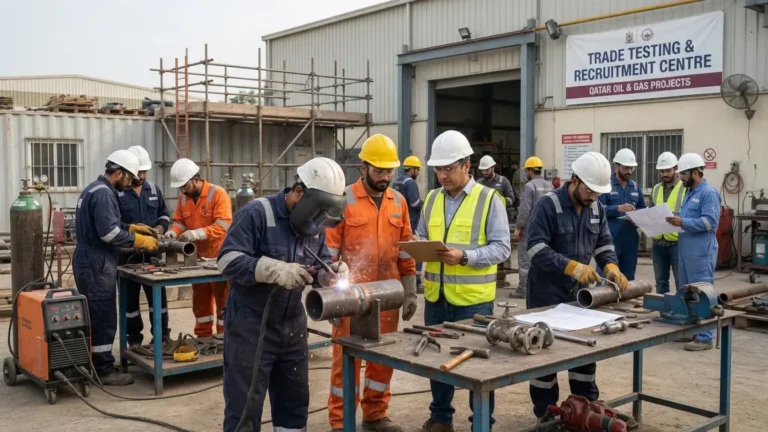
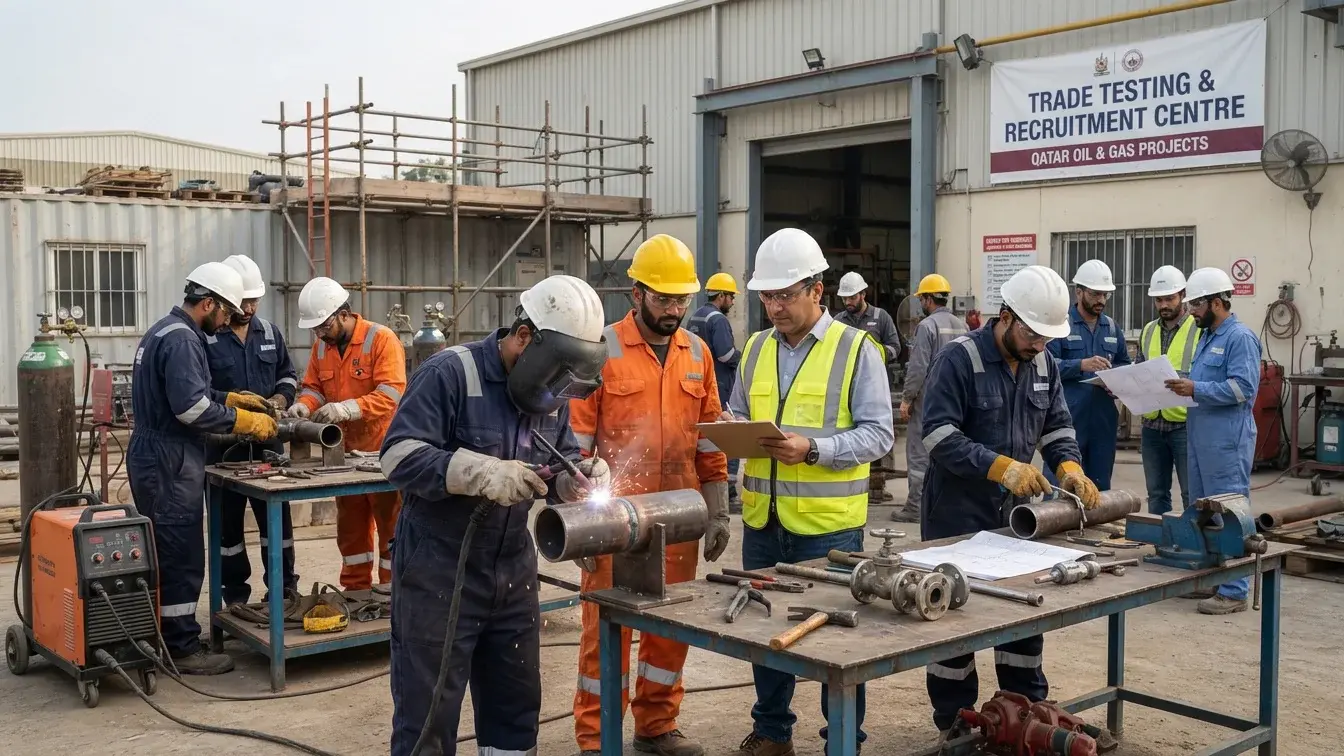
- Trade testing. Technical candidates take a practical test matched to the job: a weld coupon, a pipe fit-up, a panel wiring task, or a driving test.
- Interviews and selection. The employer interviews shortlisted candidates in Pakistan or online and issues offers.
- Qatar Visa Center appointment. Each worker books at the QVC in Islamabad or Karachi, then digitally signs the employment contract, enrols biometrics and completes the medical test there.
- Protector of Emigrants registration. Once the visa is issued, the worker registers with the Protectorate of Emigrants. This includes State Life insurance and the Overseas Pakistanis Foundation welfare fund, and it puts the protector stamp in the passport.
- Pre-departure briefing and travel. Contract terms, Qatar labour rights, site safety basics and what to expect on arrival, followed by ticketing.
- Arrival in Qatar. The employer completes the residence permit (Qatar ID) formalities and site induction.
Pakistani agencies handle steps three to nine. Our manpower recruitment service covers sourcing and screening, our trade testing centre runs the practical tests, and our visa processing support covers the QVC, protector and travel paperwork.
Do Pakistani workers need a GAMCA medical for Qatar?
No. Qatar doesn’t use GAMCA medical centres for Pakistani work visas. Pakistan’s Foreign Office states that Pakistanis going to Qatar for work complete the contract, medical examination and related formalities through the QVC in Islamabad or Karachi. Candidates who pay for a GAMCA slip for a Qatar job are wasting money, and a recruiter who asks for one is a warning sign.
What documents should candidates prepare?
- Passport with at least the validity the employer specifies (aim for well over a year)
- CNIC
- Updated CV listing plants, projects, equipment and codes
- Educational and trade certificates (attested where the employer asks)
- Experience letters from previous employers
- Current safety and trade certificates (H2S, BOSIET, welder qualification, NEBOSH and so on)
- Passport photographs to the size requested
- Driving licence and GCC licence, for driver roles
At the Protectorate stage, BEOE also requires the signed employment contract, the fee receipts and the State Life insurance certificate. The OEP prepares most of this, but the worker must attend.
How long does it take?
There’s no honest single number, because the slowest step decides the timeline. The usual bottlenecks are Ministry of Interior visa approval on the Qatar side, QVC appointment availability, the number of candidates who fail the trade test or medical, and employer interview scheduling. When we receive a demand, we give a stage-by-stage timeline based on headcount and trades rather than a blanket promise. Be cautious of any agency that guarantees a date before the visa approval exists.
What will workers be paid, and who pays the fees?
Qatar’s wage floor
Qatar’s Law No. 17 of 2020 set a minimum basic wage of QAR 1,000 a month for all workers. If the employer doesn’t provide accommodation and food, it must add at least QAR 500 for housing and QAR 300 for food. Since 2020, workers have also been able to change jobs without a no-objection certificate from their employer.
Oil and gas pay sits well above that floor for skilled trades. As examples, published BEOE demands for Qatar have listed Authorized Gas Testers at QAR 1,500 to 2,500, confined space attendants at QAR 1,100 to 1,600, instrument tube fitters at QAR 1,500 to 1,800, and pipe and structural fabricators at QAR 1,800 to 2,100, usually with free accommodation and food. These are individual demands, not market averages, and offers vary by employer, project and experience.
Recruitment fees under Qatari and Pakistani rules
Article 33 of Qatar’s Labour Law (Law No. 14 of 2004) prohibits licensed recruiters from collecting recruitment fees or other charges from the workers they recruit. Qatar’s labour ministry and the ILO both promote the principle that no worker should pay to get a job.
On the Pakistani side, BEOE publishes a fixed emigrant fee structure. For a worker recruited through an OEP, it lists OEP service charges of Rs 15,000, an OPF welfare fund contribution of Rs 4,000, a State Life insurance premium of Rs 2,500, a registration fee of Rs 500 and an OEC fee of Rs 200, a total of Rs 22,200. Qatar’s fair-recruitment approach expects employers, not workers, to carry recruitment costs, and the ILO has pushed for this to be checked during contract bidding. Employers should state in the demand letter who pays what, and workers should get a receipt for every payment.
How do you choose a Qatar recruitment agency in Pakistan?
A good Qatar recruitment agency in Pakistan saves time; a bad one can get your company’s name attached to a fraud complaint. Before you sign a power of attorney, check these points.
- Licence: the OEP licence number should appear on the agency’s website and letterhead, and you can check it on the BEOE website. BEOE also publishes complaints, warnings and suspensions against OEPs.
- Trade testing: ask whether testing happens at a registered centre and whether you can witness it or receive video and test sheets.
- Screening depth: ask how they verify experience letters and certificates, not only whether they collect them.
- Fee transparency: a written breakdown of what the worker pays, what the employer pays and what is government fee.
- Communication: one named contact, regular status reports per candidate, and a clear process for replacements if a worker fails the medical or withdraws.
Darul Ayesha is a licensed Overseas Employment Promoter (licence OP&HRD/5147/RWP/2024) based in Satellite Town, Rawalpindi, recruiting for Qatar, Saudi Arabia, the UAE, Oman, Kuwait and Bahrain. You can read more about our team and licence.
How can candidates spot a fake Qatar oil and gas job?
Oil and gas offers attract scammers because the salaries look high. These are the patterns that should make you stop:
- The offer has no BEOE permission number, or the number doesn’t show up on the BEOE foreign jobs portal.
- The agent asks for money before a confirmed demand and visa exist.
- You’re told to travel on a visit visa and “convert it” in Qatar. Pakistan’s embassy in Doha states that a visit visa cannot be converted into a work visa under Qatari law.
- You’re asked to pay for a GAMCA medical for a Qatar job.
- The agency’s licence number is missing, expired or belongs to a different company.
If you’re unsure, the Migrant Resource Centre in Pakistan runs a free helpline for intending emigrants, and BEOE lists every licensed OEP.
Frequently asked questions
Which oil and gas roles are most in demand in Qatar?
Pipe fitters, fabricators, coded welders, riggers, industrial electricians, instrument technicians, safety officers, permit roles such as gas testers and confined space attendants, QA/QC inspectors and drivers. Demand rises around construction packages and planned shutdowns.
Is Gulf experience required for oil and gas jobs in Qatar?
It’s preferred, especially for supervisors, inspectors and offshore roles. Employers often accept candidates with strong plant experience in Pakistan if their trade test and certificates are solid.
Where do Pakistani workers do their medical for Qatar?
At the Qatar Visa Center in Islamabad or Karachi, during the same appointment where they sign the contract and give biometrics. GAMCA is not used for Qatar.
What is the minimum salary in Qatar?
QAR 1,000 basic per month, plus QAR 500 for accommodation and QAR 300 for food if the employer doesn’t provide them. Skilled oil and gas trades are normally paid above this.
Can an employer hire directly without a Pakistani agency?
A worker can go abroad as a direct emigrant and register with the Protector of Emigrants independently. For bulk or technical hiring, most employers use a licensed OEP to handle the demand approval, screening, trade testing and protector paperwork.
How do I check whether a recruitment agency is licensed?
Look up the OEP licence number on the BEOE website, which lists licensed promoters and publishes complaints and suspensions. Darul Ayesha’s licence number is OP&HRD/5147/RWP/2024.
Hiring oil and gas crews for Qatar? Start with the demand
If you have a Qatar project, shutdown or maintenance contract coming up, send us the trades, headcount, salary terms and mobilisation date. We’ll tell you which roles we can source and test, what each candidate will need for the QVC, and a realistic timeline. See our Qatar recruitment services from Pakistan or send your manpower requirement.
Call 051-8484180, WhatsApp +92 318 0568107, or email info@darulayesha.com. Office hours are Monday to Saturday, 9:00 AM to 5:00 PM (PKT).