Last reviewed: 26 November 2026. Giga-project plans in Saudi Arabia changed sharply during 2025 and 2026, so we date every update and link the source.
Quick answer
NEOM recruitment from Pakistan still works in 2026, but demand has shifted. Construction on The Line has been halted until after 2030, so much of the new trade hiring is connected to Oxagon’s port, AI data centre and utilities, alongside the teams building and operating Red Sea Global’s resorts. Saudi employers issue work visas and appoint licensed Overseas Employment Promoters (OEPs) in Pakistan. Workers complete the required Takamol skill verification, Wafid medical and Protector of Emigrants registration before departure.
This guide is written for HR managers, procurement leads and project directors at Saudi contractors and subcontractors. It covers where giga-project manpower demand actually sits right now, which trades to source, how the legal pathway works on both sides, who pays for what, and the recruitment mistakes that have damaged hiring on these sites before.
Key facts at a glance
| Item | Current position | Source |
|---|---|---|
| Pakistani workers who went to Saudi Arabia in 2025 | 530,256, up 17% on 2024 | BE&OE data via Business Recorder |
| Pakistani workers to Saudi Arabia, Jan to Oct 2026 | 294,297 of 476,238 total overseas departures | BE&OE data via TechJuice |
| Takamol skill verification | 108 approved trades in 14 occupation groups; USD 85 per test from 9 September 2026 | NAVTTC |
| Takamol pass rate | 292,556 of 366,157 candidates qualified, July 2025 to March 2026 (about 80%) | Pakistan Economic Survey via Arab News |
| Who pays recruitment, iqama and work permit fees | The employer | Saudi Labor Law, Article 40 |
| Summer outdoor work ban | 12:00 to 15:00, 15 June to 15 September | MHRSD |
What is the state of NEOM and Red Sea Global hiring in 2026?
Short answer: NEOM is hiring selectively for industrial, digital and utility work, while Red Sea Global is hiring to operate what it has built. If your plan still assumes mass mobilisation for The Line, it needs revising.
NEOM: what has paused
In May 2026, Semafor reported that NEOM had halted work on The Line until after 2030, following a strategic review led by CEO Aiman al-Mudaifer.
A follow-up report put the cost of cancelling NEOM contracts at around USD 16 billion, while noting that NEOM still plans to spend SAR 40 billion on new development, mostly on Oxagon and utilities.
In October 2026, Reuters reported that the 46,000-seat NEOM Stadium planned for the 2034 World Cup had been shelved indefinitely. Public Investment Fund Governor Yasir Al-Rumayyan has said no NEOM projects were cancelled, but the practical effect on site labour is clear: far fewer general construction workers on The Line and Trojena.
NEOM: what is still being built
- Oxagon AI data centre. HUMAIN and DataVolt announced on 31 August 2026 that construction had started on the 360MW first phase of a planned 1.5GW campus at Oxagon. Data-centre builds consume electricians, cable jointers, chiller and HVAC technicians, pipe fitters and civil trades in large numbers.
- NEOM Green Hydrogen. Construction of the USD 8.5 billion plant is complete and the facility has entered commissioning, with commercial operations targeted for 2027. That shifts demand towards instrument, electrical and mechanical maintenance technicians.
- Port, rail and utilities. MEED has reported plans for an Oxagon freight rail connection to the SAR network and contractor bids for an Oxagon wastewater plant. These packages need heavy drivers, equipment operators, welders, pipe fitters and masons.
- Clean-energy manufacturing. Oxagon’s CEO said he expects companies to start building solar and wind factories in 2026. Treat this as a forecast until contracts are awarded.
Red Sea Global: from developer to operator
Red Sea Global (RSG) described 2026 as the year it moves from developer to operator, with Phase One of both The Red Sea and AMAALA opening by year end.
AMAALA launched in November 2025 with six resorts, a yacht club, a marine life institute and a marina village, and RSG expects it to create up to 50,000 jobs on completion.
RSG’s procurement head has said the whole scheme is expected to complete by 2030, and a new pipeline is forming at King Salman Bay north of Jeddah, where RSG tendered marine infrastructure works in June 2026.
For anyone searching Red Sea Global jobs, the opportunity is now split in two: finishing and fit-out work on remaining resorts and infrastructure, and long-term operations roles in facilities management, maintenance, landscaping, marine services and back-of-house hospitality.
Our read for employers
Expect fewer requests for thousands of general labourers and more requests for smaller, tightly specified batches of MEP, commissioning, port and facilities trades. Those batches fail on skill verification and paperwork far more often than on headcount, which is why the screening steps later in this guide matter.
Which specialized trades are in demand for NEOM and Red Sea Global?
The table maps each active workstream to the trades Saudi contractors are sourcing and the Takamol occupation groups those trades usually fall under. Always confirm the exact occupation title on the SVP list, because the test follows the occupation printed on the visa.
| Active workstream | Trades to source from Pakistan | Typical Takamol group | Related Darul Ayesha page |
|---|---|---|---|
| Oxagon AI data centre | HV/LV electricians, cable pullers and jointers, HVAC and chiller technicians, pipe fitters, steel fixers, shuttering carpenters, scaffolders | Electrical; Mechanical; Civil and Construction | Electricians, Construction |
| Oxagon port and freight rail | Heavy vehicle drivers, equipment and crane operators, diesel mechanics, welders | Driving; Automotive; Mechanical | Transport, Mechanical |
| Green hydrogen commissioning and O&M | Instrument technicians, mechanical fitters, electrical maintenance technicians, machine operators | Mechanical; Electrical | Mechanical |
| Water and wastewater utilities | Pipe fitters, plumbers, pump mechanics, masons | Mechanical; Civil and Construction | Construction |
| RSG resort operations and facilities management | AC technicians, maintenance electricians, plumbers, painters, irrigation and landscaping staff | Electrical; Mechanical; Civil and Construction | Housing and maintenance |
| RSG back-of-house hospitality and transport | Cooks, kitchen helpers, laundry staff, light and heavy drivers | Hospitality; Driving | Transport |
Why source specialized labor from Pakistan for Saudi giga projects?
Pakistan is the largest single source of specialized labor for Saudi Arabia, and the numbers explain why.
- Depth of supply. Saudi Arabia has employed about 7.87 million Pakistanis since 1971, and received 530,256 in 2025 alone, nearly 70% of Pakistan’s overseas employment that year (ProPakistani, BE&OE data).
- Skill testing happens before departure. Pakistan was the first country to sign the Skills Verification Program agreement with Takamol, and tests run inside Pakistan through NAVTTC at 62 centres, 44 of them active (NAVTTC). You can reject a weak candidate before you pay for a ticket.
- A deliberate national pipeline. Pakistan’s Economic Survey says the country is aligning workforce planning with Vision 2030 and the 2034 World Cup, targeting 300,000 to 400,000 trained workers between 2026 and 2034 (Arab News).
- Saudi demand signals. In late 2026, a Pakistani recruiter said three or four large Saudi companies told him they had been encouraged to hire more Pakistanis (Arab News). That is an industry account, not an official policy statement, so weigh it accordingly.
There is a counterweight. Overseas departures from Pakistan fell to 476,238 in the first ten months of 2026, against 763,536 for all of 2025 (TechJuice), and promoters blame tougher documentation and slower processing. Employers who start the paperwork early get first pick of tested candidates.
How does recruitment from Pakistan for NEOM projects work?
The legal pathway has two halves: Saudi approvals that the employer controls, and Pakistani emigration steps that the OEP controls. Here is the sequence for a typical contractor batch.
- Confirm visa quota and occupation titles. Secure work visa approvals for the exact occupations you need. The occupation on the visa decides which Takamol test applies and what the worker may legally do on site.
- Appoint a licensed OEP. Send a demand letter (trades, headcount, salary, benefits, contract length, site location) and a power of attorney to a BE&OE-licensed promoter, attested as Saudi procedures require.
- Demand permission in Pakistan. The OEP applies to the Bureau of Emigration and Overseas Employment for permission to process your foreign demand. No lawful recruitment can start without it.
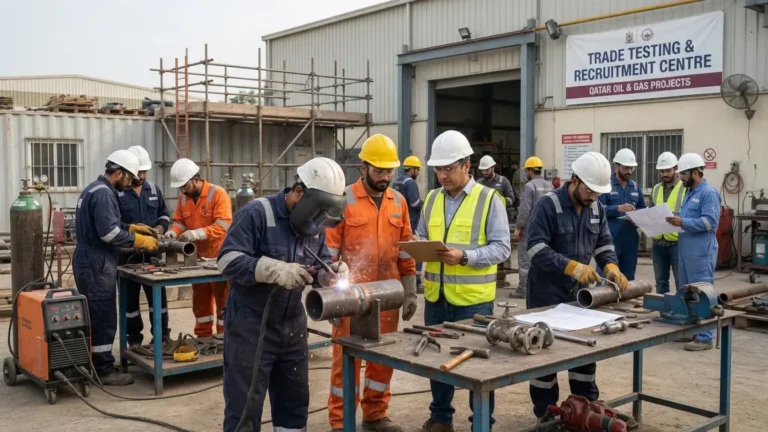
- Source and pre-screen. The OEP shortlists candidates, checks experience letters and runs a practical trade test before any client interview. At Darul Ayesha this happens through a NAVTTC-registered testing partner; see our trade testing service.
- Client selection. Your engineers interview and test shortlisted candidates in person in Pakistan or by video, and approve final names.
- Takamol skill verification. Selected workers in notified occupations book the SVP test online, pay USD 85 and receive results on the portal within 24 hours of passing (NAVTTC).
- Wafid (GAMCA) medical. Workers book through wafid.com and attend an approved centre. Results have a limited validity window, so time medicals close to visa stamping.
- Visa stamping and contract verification. The OEP submits documents for visa endorsement and verifies the employment contract against your demand. Our visa processing team handles this file.
- Protector of Emigrants registration. Each worker pays the government insurance, OPF welfare and registration fees and receives the protector stamp required under the Emigration Ordinance, 1979.
- Pre-departure briefing and mobilisation. Workers are briefed on the contract, camp rules, heat safety and grievance channels, then flown to the nearest airport for your site, such as NEOM Bay, Al Wajh or Red Sea International.
What controls the timeline?
Many agencies quote four to eight weeks from demand to deployment. That is realistic only when visas and occupation titles are correct on day one. The table shows where time is really lost.
| Stage | What usually causes delay | How to avoid it |
|---|---|---|
| Visa and demand | Occupation titles that do not match the trade; missing attestation | Agree titles with your recruiter before applying for visas |
| Screening | Unverifiable experience letters; candidates who fail a practical test | Insist on a practical trade test before shortlisting |
| Takamol | Limited slots in some cities; retakes after failure | Book tests in batches and pre-test candidates |
| Medical | Unfit results; expired reports | Schedule medicals once visa endorsement is close |
| Protector and travel | Incomplete documents; flight capacity to remote airports | Pre-check files and block flights early |
Who pays what when hiring Pakistani workers for Saudi Arabia?
Saudi law is direct on this point. Article 40 of the Labor Law says the employer bears the recruitment fees for a non-Saudi worker, residence and work permit fees and their renewal, related fines, profession-change fees, exit and re-entry fees and the return ticket (MHRSD). An ILO summary of Saudi rules notes a SAR 10,000 fine where an employer charges the worker any of these costs (ILO).
| Cost item | Normally paid by | Basis |
|---|---|---|
| Recruitment fees, iqama, work permit, renewals, exit and re-entry, return ticket | Employer | Saudi Labor Law, Article 40 |
| OEP service charges in Pakistan | Regulated and must be receipted; employers following employer-pays policies cover them | Emigration Rules, 1979 (Rule 15) |
| Takamol SVP test (USD 85) | Paid online by the candidate; the employer can reimburse | NAVTTC / Takamol |
| Wafid medical booking and clinic charges | Candidate, unless the employer reimburses | Wafid / Gulf Health Council |
| Protector fees: life insurance Rs 2,500, OPF welfare fund Rs 4,000, registration Rs 500 through an OEP | Worker (government fees) | BE&OE fee structure (summary) |
Developer welfare standards and investigations by rights groups have turned fee transparency into a compliance issue, so keep receipts for every payment in each worker’s file. Darul Ayesha gives job seekers clear written terms before they commit, and we can share that documentation with your compliance team.
What makes giga project manpower different from standard Saudi hiring?
Developer welfare standards apply to your workers
NEOM’s supplier code of conduct applies to contractors and sub-contractors registered with NEOM, and NEOM has issued a Worker Welfare Minimum Standard covering accommodation, transport and employment practices. Contractors should be ready to show that the terms offered in Pakistan match what workers receive on site.
The reputational risk is documented
Human Rights Watch’s December 2024 report on Saudi giga projects described workers who paid recruitment fees and were placed in different jobs and wages than they were promised.
A 2025 Business and Human Rights Resource Centre investigation into Saudi renewable projects, including NEOM’s green hydrogen site, found workers had paid over USD 1,600 on average in recruitment fees. Most of these failures start with unlicensed sub-agents in the source country, which is exactly the risk a licensed OEP with documented, receipted processes removes.
Remote sites and extreme heat
NEOM and RSG sites sit hours from major cities on the northwest coast. Workers need camp accommodation ready on arrival and a briefing on site rules. The Ministry of Human Resources bans outdoor work under direct sun from 12:00 to 15:00 between 15 June and 15 September, so summer arrivals should be acclimatised and scheduled around those hours.
Five recruitment mistakes that stall giga-project batches
- Visa occupation does not match the job. A pipe fitter on a helper visa cannot sit the right Takamol test or legally do the work. Fix: agree occupation titles with your recruiter before applying for visas.
- Skipping the practical test. Paying for Takamol, medicals and visas on candidates who were never tested on a real task wastes weeks. Fix: practical trade test first, then client interview.
- Medicals done too early. Reports can expire while visas are pending. Fix: sequence medicals after visa endorsement is near.
- Working through unlicensed sub-agents. This is how illegal fees and contract substitution enter the chain. Fix: contract only with a BE&OE-licensed OEP and verify the licence yourself.
- No pre-departure briefing. Workers who arrive without understanding the contract, camp rules or heat protocol leave early. Fix: require a documented briefing before every flight.
How do you verify a Pakistani recruitment agency before signing?
- Check the licence. Every OEP holds a licence number in the format OP&HRD/number/city/year. Search it on the BE&OE website, which also publishes licence cancellations.
- Visit or video-call the office. A licensed promoter operates from a registered address you can confirm.
- Ask for written terms and receipts. Fees outside the regulated schedule are a warning sign.
- Ask how candidates are tested. You want a practical test at a registered centre, not a CV forward.
For reference, Darul Ayesha’s licence is OP&HRD/5147/RWP/2024, and our office is at 50-A/2, Satellite Town, near Brain Surgery Hospital, Iran Road, Rawalpindi. You can read more about our team and history, which goes back to 2008.
How Darul Ayesha supports contractors working on NEOM and Red Sea Global packages
Darul Ayesha is a licensed Overseas Employment Promoter recruiting for employers in Saudi Arabia, the UAE, Qatar, Oman, Bahrain and Kuwait. If your company holds or is bidding for Oxagon, utilities or RSG work, we can run the Pakistani side of the process end to end:
- Manpower recruitment across six sectors: construction, mechanical, electrical, transport, housing and healthcare.
- Trade testing and screening through a NAVTTC-registered partner before your interview.
- Visa and documentation support, including demand permission, contract verification and Protector registration.
- Pre-departure briefings covering contract terms, site conduct and heat safety.
Our Saudi Arabia recruitment page explains the country-specific steps in more detail, and you can browse every industry we recruit for.
Planning a batch for NEOM, Oxagon or Red Sea Global?
Send your trade list, headcount, salary and start date. We will reply with a screening plan and a document checklist for your demand.
You can also call 051-8484180 or message us on WhatsApp.
Frequently asked questions
Is NEOM still hiring in 2026?
Yes, but selectively. Work on The Line was halted until after 2030, according to Semafor, while Oxagon’s AI data centre, port, utilities and the green hydrogen plant remain active. Most trade hiring happens through the contractors on those packages rather than through NEOM directly.
Can Pakistani workers apply directly for NEOM jobs?
Professional staff roles appear on NEOM’s own careers channels. Skilled trade workers are usually employed by NEOM’s contractors and sub-contractors, who recruit through licensed agencies in Pakistan. Treat any ‘NEOM visa’ offered for cash by an unlicensed agent as a likely scam, and verify the agency’s licence on the BE&OE website.
Is the Takamol test required for NEOM and Red Sea Global jobs?
The requirement follows the occupation, not the project. If the occupation on the worker’s visa is one of the trades notified by Takamol, the worker must pass the Skill Verification Program test before travelling. NAVTTC lists 108 approved trades, and the fee is USD 85 per test from 9 September 2026.
How long does it take to hire workers from Pakistan for a Saudi giga project?
Agencies commonly quote four to eight weeks, but the real driver is how ready your visas are. Correct occupation titles, early Takamol bookings and well-timed medicals keep a batch on schedule; mismatched titles or failed tests add weeks.
Who pays recruitment fees for Pakistani workers going to Saudi Arabia?
Under Article 40 of the Saudi Labor Law, the employer pays recruitment fees, iqama and work permit fees and renewals, exit and re-entry fees and the return ticket. Workers pay certain Pakistani government fees for Protector registration, such as insurance and the OPF welfare contribution.
Does Red Sea Global hire foreign workers?
Red Sea Global’s resorts and infrastructure are delivered and run largely through contractors, hotel operators and facilities-management firms, and these employers do hire foreign technical and back-of-house staff. Saudization targets mean many customer-facing roles are prioritised for Saudi nationals.
Sources
- Semafor: NEOM halts work on The Line until after 2030 (22 May 2026)
- Semafor: NEOM faces USD 16 billion bill to cancel contracts (7 June 2026)
- Dezeen, citing Reuters: NEOM Stadium shelved (5 October 2026)
- NEOM newsroom: HUMAIN and DataVolt begin Oxagon data centre (31 August 2026)
- MEED: Construction completed on NEOM green hydrogen project (14 August 2026)
- Arabian Business: Oxagon to start building solar and wind factories
- Saudi Gazette: Red Sea Global moves from developer to operator (10 February 2026)
- Red Sea Global: AMAALA opening announcement
- MEED: RSG tenders King Salman Bay marine works (25 June 2026)
- NAVTTC: Takamol Skill Verification Program
- Arab News: Pakistan aligns labor strategy with Vision 2030
- Business Recorder: Over half a million Pakistanis moved to Saudi Arabia in 2025
- TechJuice: Overseas employment January to October 2026
- MHRSD: Saudi Labor Law Article 40
- ILO: Saudi Arabia labour migration summary
- MHRSD: 2026 midday outdoor work ban
- BE&OE: Emigration Rules, 1979 (updated 2023)
- Human Rights Watch: Die First, and I’ll Pay You Later (December 2024)
- Business and Human Rights Resource Centre: Migrant workers in Saudi energy projects (2025)
- NEOM supplier code of conduct
This guide gives general information on recruitment procedures and is not legal advice. Rules and fees change; confirm current requirements with BE&OE, NAVTTC and the Saudi Ministry of Human Resources and Social Development before acting.
Hospitality recruitment caution: RSG runs its own vocational training programme to prepare Saudi nationals for luxury hospitality, technical services and wellness roles, and Saudization (Nitaqat) targets apply to every employer. Plan expatriate hiring mainly around technical and back-of-house roles, and check your Nitaqat band before requesting visas for customer-facing positions.