By the Darul Ayesha recruitment team · Updated 25 November 2026
Last reviewed: 25 November 2026. Fees and rules below come from official Saudi and Pakistani sources where available. Check the linked portals before you pay anything, because both governments revise them often.
If you manage hiring for a Saudi contractor, facilities company or developer, you already know the problem. A plumber who looks fine on paper can arrive, fail a pressure test on day three and cost you a visa, a ticket and a month of lost output. This checklist is built to stop that from happening. It walks you through every step of recruiting plumbers in Saudi Arabia from Pakistan, from writing the trade spec to the worker’s first week on site, and it names the specific systems you’ll deal with along the way: Qiwa, Takamol, Wafid, Etimad and the Protector of Emigrants.
Quick answer: how do you recruit plumbers for Saudi Arabia?
- Define the exact plumbing scope and match it to a Takamol trade title and a Qiwa occupation.
- Issue the work visa on Qiwa and send an attested demand letter and power of attorney to a licensed Pakistani recruiter (OEP).
- Screen candidates with a practical test of your own, then have shortlisted plumbers pass the mandatory Takamol Skill Verification Program (SVP) test through NAVTTC.
- Complete the Wafid medical, visa stamping through Etimad, the written Qiwa contract and Protector of Emigrants registration.
- Plan for arrival, iqama issue, site induction and a probation period of up to 180 days.
The checklist at a glance
Use this table as your project tracker. Each row is explained in detail below.
| # | Checklist step | Owner | Done when |
|---|---|---|---|
| 1 | Define the plumbing scope | Employer | Role, grade and scope agreed with the site or FM manager |
| 2 | Write a testable job spec | Employer + recruiter | Spec lists systems, materials, codes and tests |
| 3 | Secure the visa and occupation on Qiwa | Employer | Visa issued with the correct occupation title |
| 4 | Choose a licensed recruitment partner | Employer | OEP licence verified on the BE&OE list |
| 5 | Attest the demand letter and power of attorney | Employer + OEP | Protector permission granted for the demand |
| 6 | Pre-screen and run a practical test | OEP + employer | Shortlist with test scores and video evidence |
| 7 | Pass the Takamol plumber trade test | Candidate (via OEP) | SVP certificate uploaded to the candidate’s portal |
| 8 | Complete the Wafid medical | Candidate | Fit result uploaded to Wafid |
| 9 | Agree and document the contract | Employer | Written fixed-term contract ready for Qiwa |
| 10 | Stamp the visa through Etimad | OEP | E-visa issued |
| 11 | Protector registration and pre-departure briefing | OEP + candidate | Protector stamp, insurance and briefing complete |
| 12 | Arrival, iqama and onboarding | Employer | Iqama issued, induction done, probation tracked |
Why are plumbers hard to hire in Saudi Arabia right now?
Plumbing sits inside MEP (mechanical, electrical and plumbing), and that’s where Saudi Arabia’s skills squeeze is tightest. Turner & Townsend reports that demand for skilled labour stays high in MEP trades and finishing roles, which pushes contractors to compete for the same people.
The market has also changed shape. AGBI reported in August 2026 that construction headcount growth has slowed to single digits as giga-projects are recalibrated, so the era of hiring ahead of demand is over. At the same time, MEED notes that large developers moving from construction into operations are creating new work for MEP contractors and facility managers. For you, that means fewer bulk orders and more targeted hires, where every plumber has to be productive from week one. Quality of screening matters more than speed of volume.
Step 1: Define exactly what kind of plumber you need
“Plumber” covers very different jobs. A villa maintenance plumber, a high-rise drainage installer and an industrial pipe fitter don’t share the same test, tools or pay band. Pin this down first, because it decides the visa occupation, the Takamol trade and the salary.
| Role you need | Typical work | Closest Takamol trade title to check |
|---|---|---|
| Building services plumber | Water supply, drainage, sanitary fixtures in residential and commercial buildings | Plumber / Plumbing |
| Maintenance (FM) plumber | Leak finding, pump and heater servicing, fixture replacement in occupied buildings | Plumber |
| Pipe installer | Running supply and drainage lines on new-build sites | Pipe Installer |
| Pipe fitter | Measuring, cutting, threading and assembling pipework to drawings | Pipe Fitting and Assembly Technician |
| Heating and boiler pipework | Boiler, hot-water and heating pipe systems | Pipe and Boiler Installer |
| Pipe fabricator | Shop or site fabrication of pipe and tube assemblies | Pipe and Tube Fabricator |
These trade titles appear on NAVTTC’s list of approved Takamol trades. The mapping above is a starting point, not an official ruling. Confirm that the trade a candidate tests in matches the occupation on the visa before anyone books a test.
Also decide the grade: helper, plumber, senior plumber or plumbing foreman. Mixing grades in one demand without separate specs is one of the most common reasons shortlists disappoint.
Step 2: Write a job spec a tester can actually check
Most plumber job descriptions say “3 to 5 years’ experience, knowledge of plumbing”. That tells a recruiter nothing. A useful spec lists things that can be observed in a practical test. Include:
- Systems: cold and hot water supply, soil and waste drainage, storm water, booster pumps, roof and ground tanks, water heaters.
- Materials and joining methods: for example PPR heat fusion, uPVC solvent welding, copper brazing, threaded galvanised steel or HDPE, depending on your sites.
- Drawings: whether the plumber must read isometric and shop drawings or only follow a supervisor’s markings.
- Testing and commissioning: pressure testing supply lines, water or air testing drainage, and recording results.
- Codes: Saudi building work follows the Saudi Plumbing Code, SBC 701, which is based on the International Plumbing Code (IPC). Some industrial and Aramco-linked projects use their own engineering standards, so say which applies.
- Site conditions: high summer heat, occupied buildings, working at height or confined spaces.
- Language: basic Arabic or English for site instructions, if it matters to you.
A spec written this way lets your recruiter design a practical screen that mirrors your real work, and it gives you grounds to reject a candidate who interviews well but can’t do the job.
Step 3: Secure the visa and the right occupation on Qiwa
In Saudi Arabia the employer, not the worker, starts the process. Companies issue work visas through the Qiwa platform run by the Ministry of Human Resources and Social Development (MHRSD). The candidate’s passport is later linked to that visa.
Two things to get right at this stage:
- Occupation title. The occupation on the visa should match the trade the candidate tests in under the Skill Verification Program. A mismatch can stall the case at stamping.
- Cost ownership. Under the Saudi Labour Law, the employer bears recruitment fees, work permit and iqama costs for non-Saudi workers. Budget for these from the start, and don’t let any intermediary pass them on to the worker.
Since April 2026, MHRSD has also tightened rules around documenting employment contracts on Qiwa. Plan to register every new plumber’s contract electronically once they arrive.
Step 4: Choose a licensed recruitment partner in Pakistan
Saudi Arabia is Pakistan’s biggest overseas job market: BE&OE data shows 530,256 of the 762,499 Pakistanis registered for overseas jobs in 2025 went there. Under Pakistani law, recruitment for overseas jobs must run through an Overseas Employment Promoter (OEP) licensed by the Bureau of Emigration and Overseas Employment (BE&OE), or through direct employer registration with the Protector. Travel agents can’t legally arrange jobs or work visas.
Before you sign with any agency, check:
- The OEP licence number appears on the BE&OE list of licensed OEPs and isn’t suspended.
- The agency has a physical office you can visit or video-call.
- It can show you how it screens plumbers, not only how fast it sources them.
- It states in writing what the worker pays and what you pay, with receipts.
Darul Ayesha, for example, is a licensed OEP (licence OP&HRD/5147/RWP/2024) based in Satellite Town, Rawalpindi. You can read more on our manpower recruitment service.
| Sourcing route | Best for | Watch out for |
|---|---|---|
| Local transfer hire inside KSA | Urgent single hires | Limited pool, transfer rules, higher salary expectations |
| Job portals and social media | Supervisors and foremen | Unverified CVs, no trade testing, slow volume |
| Licensed OEP in Pakistan | Batches of tested tradespeople | Check the licence and the screening method, not only the price |
Step 5: Attest the demand letter and power of attorney
Your OEP can’t advertise or process your jobs until the demand is legal in Pakistan. You’ll issue two documents on company letterhead:
- Demand letter: trade titles, headcount, salary, allowances, working hours, contract length and benefits for each grade.
- Power of attorney: authorising the named OEP to recruit on your behalf.
These are attested by the relevant authorities and submitted to the Protector of Emigrants. BE&OE guidance reported in May 2026 confirms that Protector permission is mandatory before recruitment begins, under Article 9 of the Emigration Ordinance, 1979. The Protector checks that the terms protect the worker. Write terms you’re prepared to honour exactly, because the worker’s contract and the Protector record will be compared later.
Step 6: Pre-screen candidates with your own practical test
The official trade test confirms a minimum standard. Your own screen decides whether a plumber is right for your sites. Run it before candidates spend money on the Takamol test, so only serious contenders move forward.
A practical screen for a building services plumber might include:
- Reading a simple isometric drawing and listing the fittings needed.
- Cutting and joining a short supply run in the material you use most (PPR fusion or copper, for example).
- Installing a trap and waste connection to a basin or floor drain with the correct fall.
- Pressure testing the supply run and explaining what a failed test looks like.
- Fault-finding on a mock leak or low-pressure complaint.
Ask the recruiter for short videos of each candidate’s practical work and a score sheet. Then hold a final video interview for shortlisted candidates. Check experience letters against the employers named on them, and ask about the exact projects and materials they used. A plumber who installed PPR on villas will describe it in a different way from one who only watched.
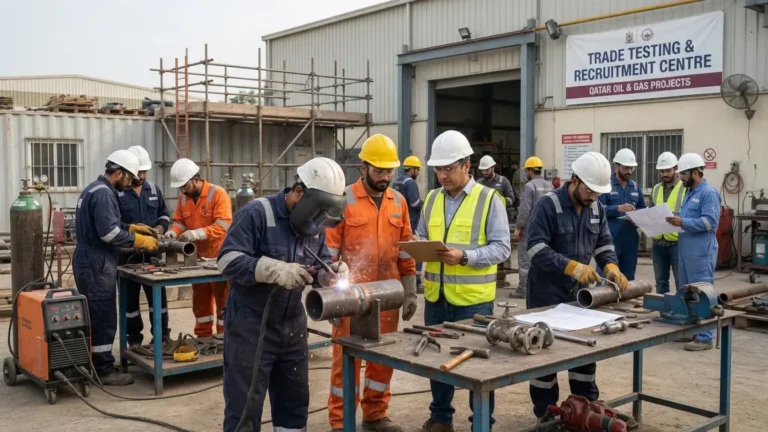
Our trade testing service covers this kind of pre-screen alongside preparation for the official Takamol assessment.
Step 7: Pass the Takamol plumber trade test (SVP)
This is the step most competitor checklists skip, and it’s the one that stops visas. Saudi Arabia enforced the Skill Verification Program (SVP) from 1 July 2021. For workers going to the Kingdom in notified occupations, verification by Takamol is mandatory. Pakistan was the first country to sign the SVP agreement, and NAVTTC (the National Vocational and Technical Training Commission) runs it in Pakistan.
Plumbing has been on the list from the start. When the external track launched in Pakistan in September 2022, plumber was one of the first five professions tested, alongside electrician, welder, AC technician and auto electrician.
How the plumber trade test works
- The candidate creates a profile on the Takamol SVP portal with passport details.
- They choose a test city, trade and date.
- They pay the test fee online. NAVTTC lists it as USD 50 per test. Some reports cite revised fees, so confirm the amount on the portal at the time of booking.
- They download the appointment slip and the system assigns an approved test centre.
- They sit a theory and practical assessment at the centre with their original passport and CNIC.
- If they pass, the result and certificate appear on their portal within 24 hours.
NAVTTC says only a valid passport and CNIC are needed to test. If a candidate fails, they rebook through the portal. Build that possibility into your schedule rather than assuming everyone passes first time.
Professional Examination vs Professional Verification
MHRSD’s Professional Accreditation programme has two services that are often confused. Professional Examination (the SVP trade test) checks skills through theory and practical tests, which is what applies to plumbers. Professional Verification checks the authenticity of academic qualifications and experience for highly skilled professions such as engineers. A plumbing foreman with a diploma may face both, so confirm with your recruiter. MHRSD also runs a second track that examines skilled workers already inside the Kingdom.
Step 8: Complete the Wafid (GAMCA) medical
Every Saudi work visa needs a fit result from the Gulf Health Council’s Wafid system, still widely called GAMCA. Candidates book through wafid.com and attend the clinic they’re assigned. Under rules updated in June 2026, only GCC-approved medical centres can carry out Wafid examinations, and results are uploaded straight to the platform before visa processing can continue.
Practical tip: time the medical close to stamping. A Wafid report is generally treated as valid for about two months, so an early medical can expire if the trade test or attestation runs late.
Step 9: Agree the contract, salary and benefits
Saudi labour law amendments that took effect in February 2025 changed some contract basics. Expatriate workers need a written fixed-term contract, and the probation period can now be up to 180 days if it’s written into the contract, with either party able to end the contract during probation. Salary is paid into a Saudi bank account under the Wage Protection System.
What do plumbers earn in Saudi Arabia?
Pay varies by grade, city, sector and whether housing and food are provided. As a market reference, Naukrigulf’s salary data puts plumber salaries in Saudi Arabia between roughly SAR 2,000 and SAR 6,000 a month, with a most commonly reported figure of about SAR 3,295. Treat that as a guide, not a rate card. Foremen, plumbers with industrial or high-rise experience and those who read drawings well usually sit at the upper end.
Beyond basic salary, spell out each of these in the demand letter and the contract:
- Accommodation (provided, or a housing allowance)
- Transport to site
- Food or food allowance
- Medical insurance
- Working hours, overtime rate and weekly rest day
- Annual leave and the return air ticket
- Contract length and end-of-service benefit
Every figure has to match what the Protector approved in Step 5. Discrepancies are a red flag for the Protector and a common source of disputes once the worker is in the Kingdom.
Step 10: Stamp the visa through Etimad
Once the visa, trade test and medical are in place, the candidate’s passport, visa (E-number) and medical report are submitted through the Saudi-authorised Etimad (Tasheer) centres, where biometrics are taken. Saudi work visas are now issued as e-visas with a QR code rather than a passport sticker. Your OEP should also check the visa against the candidate’s passport on the Saudi Ministry of Foreign Affairs visa portal before anyone pays any fee. If you need help at this stage, see our visa processing service.
Step 11: Protector registration and pre-departure briefing
No Pakistani worker should leave on a work visa without Protector registration. It records the contract, enrols the worker in the Overseas Pakistanis Foundation (OPF) welfare fund and State Life insurance, and gives the worker access to the Community Welfare Attaché at the Pakistani mission in Saudi Arabia if problems arise.
Official worker-side fees published in October 2026 for Protector processing through an OEP were:
| Item (worker pays) | Amount (PKR) |
|---|---|
| OPF welfare fund | 4,000 |
| State Life insurance (PKR 1 million cover) | 2,500 |
| Registration fee (via OEP) | 500 |
| OEC fee | 200 |
| OEP service charge | 15,000 |
| Total via OEP | 22,200 |
Source: Saudi Life Guide summary of BE&OE fees, published October 2026. Confirm current figures with the Protector of Emigrants office or BE&OE before payment.
Run a pre-departure briefing that covers the contract terms, site rules, heat-safety basics, the iqama process, wage protection and who to call for help. A plumber who knows what to expect is far less likely to abscond or quit in the first month.
Step 12: Arrival, iqama and onboarding
Recruitment isn’t finished at the airport. In the first weeks:
- Issue the iqama within the work visa’s validity window and register the contract on Qiwa.
- Open a bank account for wage payments.
- Run a site induction covering safety, permits to work, hot-weather working hours and your QA forms for pressure tests.
- Pair new plumbers with a supervisor for the first jobs and record their output.
- Use the probation period deliberately: review each plumber at 30, 90 and 150 days, so you’re making a decision well before the 180-day limit.
Who pays what when recruiting plumbers for Saudi Arabia?
| Cost | Who pays | Notes |
|---|---|---|
| Work visa, work permit and iqama | Employer | Required under Saudi Labour Law |
| Recruitment fees | Employer | The employer bears recruitment fees for non-Saudi workers |
| Takamol SVP test | Usually the candidate | Some employers reimburse it to attract better candidates |
| Wafid booking and medical | Usually the candidate | Clinic fees are set by the clinic |
| Etimad service fee | Usually the candidate | Charged per application |
| Protector, OPF, insurance, OEP service charge | Candidate | Fixed by BE&OE rules |
| Return ticket at contract end | Employer | Also state who pays the joining ticket in the contract |
If an agent asks a worker for several hundred thousand rupees “for the visa”, that isn’t an official fee. Avoid any partner that works this way, because it exposes your company to complaints, blacklisting and workers who arrive in debt.
What can delay a plumber hire?
| Stage | Common cause of delay | How to prevent it |
|---|---|---|
| Visa and occupation | Occupation title doesn’t match the trade test | Confirm the trade title before issuing the visa |
| Attestation | Missing details in the demand letter or POA | Use a checklist and send drafts to your OEP first |
| Trade test | Few available slots, failed attempts | Pre-screen first and book early |
| Medical | Report expires while waiting | Book Wafid after the trade test pass |
| Stamping | Mismatched passport or visa data | Verify on the MOFA portal before submission |
| Protector | Contract terms differ from the approved demand | Keep one master term sheet for all documents |
Red flags to avoid
- An agency that can’t show a current BE&OE licence number.
- Promises that skip the Takamol test for a notified trade.
- CVs with no verifiable employer details or experience letters.
- Salary or benefits in the contract that differ from the demand letter.
- Any request for the worker to pay employer costs such as the visa or iqama.
- Fee figures copied from an old blog post without checking the official portal.
Looking for plumber jobs in Saudi Arabia? Read this first
If you’re a plumber in Pakistan reading this, the same checklist protects you. Only deal with a BE&OE-licensed OEP. Never pay for a “visa”, because the employer covers the visa and recruitment fees. Book the Takamol test yourself on the official portal, keep every receipt and don’t travel without Protector registration. You can also ask us about current openings through our Saudi Arabia recruitment page. Listings depend on approved demands, so they aren’t a guarantee of a current vacancy.
How Darul Ayesha helps you hire plumbers for KSA
We’re a licensed Overseas Employment Promoter in Rawalpindi supplying skilled trades to employers in Saudi Arabia and across the Gulf. For plumbing roles, we:
- Help you turn a site need into a clear plumber spec and demand letter.
- Source from our trade networks and pre-screen candidates with practical tests matched to your spec.
- Guide shortlisted plumbers through Takamol registration, Wafid, Etimad and Protector registration.
- Brief every worker before departure on the contract, the site and Saudi rules.
Plumbers are often part of a wider MEP or finishing team. We also supply trades for construction projects, housing and building maintenance and mechanical works.
Need plumbers for a project in Saudi Arabia? Send us your plumber requirement with the trade grade, headcount and start date, and we’ll reply with a screening plan and a realistic timeline.
Frequently asked questions
Is the Takamol trade test mandatory for plumbers going to Saudi Arabia?
Yes, for plumbing occupations that Saudi Takamol has notified as mandatory. Saudi Arabia has enforced the Skill Verification Program since 1 July 2021, and plumber was among the first five trades tested in Pakistan when the external track launched in September 2022. The test is delivered in Pakistan through NAVTTC.
How much does the plumber trade test cost in Pakistan?
NAVTTC lists the Takamol SVP fee as USD 50 per test, paid online through the SVP portal. Some 2026 reports cite a revised fee, so check the amount on the official portal when booking.
How long does it take to hire a plumber from Pakistan for Saudi Arabia?
It depends on how quickly the visa, attestation, trade test slots and medical line up. Delays most often come from occupation mismatches, failed trade tests and expired medical reports. Pre-screening candidates and booking the Takamol test early are the most effective ways to shorten the timeline.
Who pays the recruitment fee for plumbers hired for Saudi Arabia?
Under the Saudi Labour Law, the employer bears recruitment fees, work permit and iqama costs for non-Saudi workers. Workers normally pay their own Takamol test, Wafid medical, Etimad service fee and Pakistani Protector charges.
What is the average salary of a plumber in Saudi Arabia?
Naukrigulf salary data puts plumber pay in Saudi Arabia between about SAR 2,000 and SAR 6,000 a month, with a most commonly reported figure of around SAR 3,295. Accommodation, transport, overtime and grade change the total package.
Which plumbing code is used in Saudi Arabia?
Building plumbing in Saudi Arabia follows the Saudi Plumbing Code, SBC 701, which is based on the International Plumbing Code. Some industrial and energy-sector projects apply their own engineering standards, so include the applicable code in the job spec.
How can I verify that a Pakistani recruitment agency is licensed?
Check the agency’s OEP licence number against the list of licensed Overseas Employment Promoters on the Bureau of Emigration and Overseas Employment website, and confirm it isn’t suspended. Darul Ayesha’s licence number is OP&HRD/5147/RWP/2024.