By the Darul Ayesha recruitment team · Last reviewed 25 November 2026
Saudi Arabia is still the biggest employer of Pakistani engineers and technicians, but the market for Pakistani engineers in Saudi Arabia looks different in 2026 than it did three years ago. More Pakistanis went to the Kingdom than ever in a single recent year, Saudization rules for engineers tightened, every new work permit now carries a skill level, and project spending moved away from NEOM-style megaprojects toward deadline-bound work for Expo 2030 and the 2034 FIFA World Cup.
The short answer: technicians are in volume demand, and experienced engineers are in selective demand. In 2025, 530,256 Pakistani workers registered for jobs in Saudi Arabia, a 17% rise on the 452,562 recorded in 2024, according to the Bureau of Emigration and Overseas Employment (BEOE). Engineers form a smaller, tightly regulated group: they need Saudi Council of Engineers (SCE) accreditation, usually at least five years of verified experience, and they compete inside a 30% Saudization quota that now covers 46 engineering professions.
This guide is written for two readers. If you’re a Saudi employer or HR lead planning engineering recruitment for Saudi Arabia from Pakistan, it shows where Pakistani talent fits, what the rules require and how the hiring process runs. If you’re a Pakistani engineer or technician looking at engineer jobs in Saudi Arabia, it explains which roles are realistic, what you need before you apply and how to check an offer.
Key facts at a glance (reviewed 25 November 2026)
- 530,256 Pakistanis registered for Saudi employment in 2025, about 70% of the 762,499 who went abroad that year.
- 263,773 Pakistani technicians took overseas jobs between 2023 and August 2025, behind only drivers and labourers (BEOE data via Profit).
- 8,018 Pakistani engineers left for overseas jobs in 2024 (BEOE via ProPakistani).
- 30% Saudization applies to 46 engineering professions from 31 December 2025, for firms with five or more workers in those roles.
- USD 50 is the Takamol Skill Verification Program (SVP) fee that technicians in notified trades pay before a Saudi work visa.
- 3 skill levels (high-skilled, skilled, basic) apply to every new Saudi work permit since 3 August 2025.
Why is demand for Pakistani engineers and technicians in Saudi Arabia growing?
Three forces drive it: the size of Saudi Arabia’s construction and maintenance workload, a long and well-tested recruitment corridor with Pakistan, and new Saudi rules that reward documented, verified skills over unverified headcount.
Record flows from Pakistan to the Kingdom
The numbers kept climbing through 2025. Saudi Arabia absorbed 431,545 Pakistani workers in the first ten months alone, and the full-year figure of 530,256 put the Kingdom far ahead of Qatar (68,376) and the UAE (52,664). Money followed people: Pakistanis in Saudi Arabia sent home USD 9.64 billion in 2025, up from USD 8.34 billion a year earlier, according to State Bank of Pakistan data.
Skilled categories grew alongside general labour. BEOE registrations for the first half of 2025 included 6,246 technicians, 3,599 electricians, 1,237 plumbers and 2,884 engineers. Those are small numbers next to the drivers and labourers who dominate the totals, which is exactly why well-documented technical candidates stand out to Saudi employers.
Where the project pipeline is heading in 2026
Anyone still selling Saudi demand purely on NEOM is working from an old brief. The Kingdom has sharply scaled back funding for NEOM and redirected spending toward infrastructure for Expo 2030 in Riyadh and the 2034 World Cup. By the end of June 2026, USD 92 billion in contracts had been awarded across the five official gigaprojects, but only USD 4.5 billion of that came in the first half of 2026. The Public Investment Fund’s 2026 to 2030 strategy concentrates on finishing what is already under construction.
That doesn’t mean engineering demand is drying up. MEED expects around USD 7 billion of construction contracts for the Expo site, more stadium tenders, and hotel and commercial buildings to support the events. Even at their peak, gigaprojects made up a small share of the Saudi construction market. Energy and utilities are hiring too: Punjab recently sent 250 skilled workers to Jeddah for a power plant project, including safety inspectors, fabricators and welders.
Our reading of this shift: demand is moving from concept-stage design roles toward delivery, MEP installation, testing and commissioning, and long-term operations and maintenance. Those are the stages where site engineers, MEP engineers and certified technicians carry the workload, and they are the roles Pakistan supplies in the largest numbers.
Which engineering and technician jobs are most in demand in KSA?
Most Saudi requests for Pakistani technical staff fall into six groups. The table maps each group to where the work comes from and the Saudi requirement that usually decides whether a candidate can be deployed.
| Role group | Typical job titles | Where the demand comes from | Main Saudi requirement |
|---|---|---|---|
| Civil and site engineering | Site engineer, QA/QC civil engineer, planning engineer, quantity surveyor | Expo 2030, stadiums, housing, roads and utilities | SCE accreditation; counts toward engineering Saudization |
| MEP engineering | Electrical, mechanical, HVAC and BMS engineers | Hospitals, hotels, commercial towers, data centres | SCE accreditation; five years’ verified experience |
| Electrical technicians | Building electrician, panel technician, auto electrician, electronic technician | Fit-out, facility maintenance, utilities | Takamol SVP where the occupation is notified |
| HVAC and mechanical technicians | AC technician, mechanical fitter, maintenance technician | Cooling-heavy buildings, FM contracts, industrial plants | Takamol SVP for notified trades such as HVAC |
| Welding and fabrication | Welder, fabricator, pipe fitter | Power, oil and gas, industrial projects | Takamol SVP for welding; employer weld tests |
| Health, safety and environment | Safety officer, safety inspector | Every large site | Certificates such as NEBOSH or OSHA are often requested by employers |
Pay in these demands is often lower than headline salary surveys suggest. A 2025 BEOE-approved Saudi demand, for example, listed BMS engineers and mechanical engineers at SAR 3,000 to 6,000 a month and safety officers at SAR 2,000 to 3,000, with free accommodation. Candidates should judge each offer on the full package, which we cover in the salary section below.
Employers looking for specific trades can go straight to our sector pages: hire Pakistani electricians and electrical technicians, mechanical technicians and fitters from Pakistan, or construction recruitment from Pakistan for civil and site teams.
How does Saudization affect hiring Pakistani engineers?
Saudization narrows the entry-level end of the market for foreign engineers, but it doesn’t close it. The Ministry of Human Resources and Social Development (HRSD) set a 25% Saudization rate for engineering professions from 21 July 2024. A second decision raised that to 30% across 46 engineering roles from 31 December 2025, applying to private and non-profit employers with five or more workers in the covered professions, and set a SAR 8,000 minimum salary for Saudi engineers.
- Only SCE-certified engineers count. Saudi engineers who aren’t SCE-accredited, or who sit in non-engineering roles, don’t count toward the ratio.
- Up to 70% of covered roles can still go to non-Saudis. A firm with 20 engineers in covered professions needs at least six Saudis in those roles; the rest can be experienced foreign hires.
- Technicians face a slower ramp. For technical engineering professions, HRSD is raising Saudization gradually to 30% over five years from 27 July 2025.
What this means in practice: Saudi employers now spend their foreign-engineer headcount on people who bring experience the local pipeline can’t yet supply, such as MEP coordination, commissioning, planning and site leadership. For Pakistani engineers, the message is plain. Years of documented, relevant experience matter more than ever, and a fresh degree on its own won’t carry an application.
What qualifications do Pakistani engineers need to work in Saudi Arabia?
A Pakistani engineer needs four things before an engineering visa makes sense: a recognised degree, SCE accreditation, enough verified experience, and attested documents.
- A PEC-accredited engineering degree. Pakistan became a full signatory of the Washington Accord in June 2017, so degrees from Pakistan Engineering Council (PEC) accredited programmes are recognised as substantially equivalent by other signatories.
- Saudi Council of Engineers accreditation. Saudi law says no engineering profession may be practised without SCE professional accreditation, and violations can bring fines of up to SAR 100,000 or loss of accreditation.
- At least five years of verified experience. SCE states that registration for those with less than five years of experience is not accepted unless the applicant is Saudi, and HRSD and SCE agreed to stop recruiting engineers with less than five years’ experience from abroad. Experience certificates must be genuine; engineers are held accountable if they aren’t.
- Attested documents. Have your degree and experience letters attested through the Higher Education Commission and the Ministry of Foreign Affairs before the visa stage. Your employer or recruitment agency will confirm any Saudi-side attestation the visa and SCE file need.
SCE grades engineers by experience: Associate Engineer (4+ years), Professional Engineer (8+ years) and Consultant Engineer (16+ years). The Council has also made professional exams optional for graduates from before 2025, which removes one hurdle for experienced Pakistani engineers.
One trap catches many B.Tech and DAE holders. Saudi regulations classify engineers, specialists and technicians in supporting engineering specialties as separate categories. Before you accept an “engineer” visa, confirm that your qualification matches that SCE category; a mismatch can block accreditation after you arrive.
The skill-based work permit system adds another check. Since 3 August 2025, new hires are placed in high-skilled, skilled or basic tiers based on qualifications, experience, technical ability, wage level and age. A properly documented engineer on an engineering-level salary sits in a different tier from a technician, so the job title, qualification and salary in the contract need to agree.
What do Pakistani technicians need for jobs in KSA?
For most skilled trades, the gatekeeper is the Takamol Skill Verification Program, not a degree. Takamol verification is mandatory for skilled workers heading to Saudi Arabia in notified trades, and Pakistan was the first country to sign the SVP agreement. The National Vocational and Technical Training Commission (NAVTTC) runs the testing network in Pakistan.
- What the test covers: a theory and practical assessment of about three hours at an accredited centre; a pass earns a certificate valid for five years.
- Which trades: occupations named for Pakistani applicants include mason, steel fixer, automobile technician, electronic technician, electrician and civil technician. The first Pakistani test rounds covered building electrician, welding, auto electrician, plumbing and HVAC. Always check the current notified list on NAVTTC.
- Cost: the SVP certificate fee is USD 50, paid at registration. Who pays should be agreed before the test.
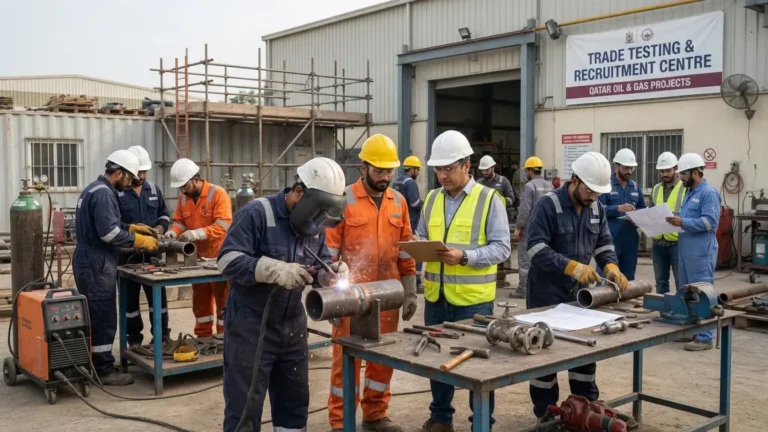
Passing SVP proves basic competence; it doesn’t prove a technician can work to a specific employer’s standard. That’s why Darul Ayesha runs a practical trade test at a NAVTTC-registered partner centre in Rawalpindi before candidates sit the Takamol assessment, so employers interview people who have already shown the skill on the tools.
Engineer vs technician: how do the routes to Saudi Arabia compare?
| Factor | Engineer | Technician |
|---|---|---|
| Pakistani credential | PEC-accredited BE/BSc Engineering | DAE, NAVTTC or TEVTA certificate, or proven trade experience |
| Saudi gatekeeper | SCE professional accreditation | Takamol SVP for notified trades |
| Experience floor | 5 years for overseas recruitment | Set by the employer; SVP tests competence |
| Saudization exposure | 30% across 46 engineering professions | Gradual rise to 30% in technical engineering professions |
| Work permit tier | Usually assessed against high-skilled criteria | Usually skilled tier |
| Typical monthly pay (estimates) | SAR 6,500 to 9,500 average by field (survey data); lower in many BEOE demands | Varies widely by trade; entry offers as low as SAR 1,600 to 1,800 reported |
| Main paperwork risk | Visa profession or degree not matching SCE category | Missing or expired SVP certificate |
How much do Pakistani engineers and technicians earn in Saudi Arabia?
Salary surveys put most expat engineers in the mid four figures to low five figures per month. GulfTalent averages compiled in November 2026 show civil engineers at about SAR 6,500, mechanical and electrical engineers at about SAR 7,000, planning engineers at SAR 8,500 and project engineers at SAR 9,500 a month, with Paylab ranges for electrical engineers stretching from roughly SAR 6,600 to 18,300. There’s no legal minimum wage for expat engineers.
Offers made through Pakistani recruitment channels often start lower, as the BEOE demand quoted above shows. Technician pay varies even more by trade and experience; in January 2026, 80 Pakistani students received technician offers of SAR 1,600 to 1,800 a month.
Compare the whole package, not the basic salary. Housing or a housing allowance, transport, annual or end-of-contract air tickets, medical insurance, overtime rules and end-of-service benefit change the real value of an offer considerably. Under Saudi Labour Law Article 40, the employer pays recruitment fees, iqama and work permit fees and their renewals, and the return ticket.
How do Saudi employers hire Pakistani engineers and technicians?
When you hire Pakistani technicians or engineers through a licensed Overseas Employment Promoter (OEP), the process follows a fixed legal sequence. Here’s how it runs at Darul Ayesha:
- Visa and requirement review. You share Qiwa visa details, trades, headcount, terms and start date.
- Demand letter and power of attorney. These are attested, and the Protector of Emigrants grants demand permission.
- Sourcing and screening. For engineers, this includes checking SCE eligibility, years of experience and document authenticity.
- Practical trade test for technicians and tradespeople.
- Takamol skill verification where the occupation is on the mandatory list.
- Wafid (GAMCA) medical.
- Contract registration on Qiwa, visa submission, biometrics and stamping.
- BEOE and Protector registration with insurance.
- Pre-departure briefing and deployment.
There’s no honest fixed turnaround. Timing depends on visa status, batch size, Takamol test availability and embassy processing, so we send a written stage-by-stage schedule once we’ve reviewed your visa. The most common delays we plan around are visa professions that don’t match the candidate’s qualification, unattested documents and limited SVP test seats in peak months.
For the full employer view, including trades we supply and fee responsibilities, see our page on hiring through a recruitment agency in Pakistan for Saudi Arabia or our Saudi work visa and documentation support.
What should Pakistani engineers and technicians check before accepting a Saudi offer?
People borrow money to go abroad, so a bad offer costs more than time. Run these checks first:
- The agency is licensed. Ask for the OEP licence number and verify it with BEOE. Darul Ayesha’s licence is OP&HRD/5147/RWP/2024.
- The job has BEOE permission. Legitimate demands carry a BEOE permission number, and you can see many of them on the BEOE foreign jobs portal.
- The visa profession matches your role. An engineer on a technician visa, or the reverse, can block SCE accreditation and affect family visa eligibility.
- You know what you pay. Under the BEOE schedule, worker charges total Rs 22,200: OEP service charges Rs 15,000, welfare fund Rs 4,000, State Life insurance Rs 2,500, BEOE registration Rs 500 and OEC Rs 200. Recruitment fees are the employer’s cost.
- The contract is registered on Qiwa and salary is paid into a bank account.
The last point isn’t a formality. In 2016, thousands of Pakistani construction workers were stranded in Saudi Arabia with unpaid wages after major contractors ran into trouble. A registered contract and bank-paid salary give you a paper trail if anything goes wrong.
What makes Pakistan a dependable source of engineering talent?
- Scale and history. Since 1972, about 7.69 million Pakistani workers have moved to Saudi Arabia, so recruitment, testing and emigration processes are well established on both sides.
- Verified skills infrastructure. Pakistan was the first country to adopt the Takamol SVP, and NAVTTC runs testing centres across the country.
- Recognised engineering education. Washington Accord membership gives PEC-accredited degrees international standing, which simplifies SCE assessment.
How Darul Ayesha supports engineering recruitment for Saudi Arabia
Darul Ayesha is a government-licensed Overseas Employment Promoter (licence OP&HRD/5147/RWP/2024, issued under the Emigration Ordinance 1979), recruiting from Rawalpindi since 2008. We supply electrical, mechanical, construction, transport, housing and healthcare staff to Saudi Arabia and the other GCC countries.
- Screening against Saudi rules for SCE eligibility, experience and document authenticity before you see a CV.
- Practical trade testing at a NAVTTC-registered partner centre, plus coordination of Takamol SVP assessments.
- Visa, medical, Protector and BEOE processing handled in-house, with a pre-departure briefing for every worker.
Planning to hire engineers or technicians for a Saudi project? Send us your visa details and headcount and we’ll reply with a written stage-by-stage schedule. Prefer to talk first? Message us on WhatsApp or call 051-8484180 (Mon to Sat, 9:00 AM to 5:00 PM PKT).
Frequently asked questions
Can a fresh Pakistani engineering graduate get an engineer job in Saudi Arabia?
Not as an engineer recruited from abroad. SCE does not register non-Saudi engineers with less than five years of experience, and HRSD and SCE agreed to stop recruiting engineers below that level from overseas. Building verified experience first is the realistic route.
Is the Takamol test required for engineers?
Engineers are assessed through Saudi Council of Engineers accreditation. The Takamol Skill Verification Program applies to occupations Saudi Arabia has notified, which are mainly skilled trades such as electricians, plumbers, welders and HVAC technicians. Check the current list on NAVTTC for your exact occupation.
Does Saudization stop Saudi companies hiring Pakistani engineers?
No. Private employers with five or more workers in the 46 covered engineering professions must keep at least 30% of those roles Saudi from 31 December 2025. The remaining roles can be filled by qualified foreign engineers, and only SCE-certified Saudi engineers count toward the quota.
Which technician jobs are most in demand in KSA?
Electricians and electrical technicians, HVAC and AC technicians, welders and fabricators, plumbers, mechanical fitters and maintenance technicians are the most common requests, driven by building services, facility maintenance, power and industrial projects.
How long does it take to hire Pakistani technicians for Saudi Arabia?
There is no fixed timeline. It depends on visa status, batch size, Takamol test availability and embassy processing. A licensed agency should give you a written stage-by-stage schedule after reviewing your visa.
Who pays the recruitment fees?
Under Saudi Labour Law Article 40, the employer pays recruitment fees, iqama and work permit fees and renewals, and the return ticket. The worker pays only the BEOE-scheduled charges in Pakistan, which total Rs 22,200. Who pays the USD 50 Takamol fee should be agreed before testing.
Are Pakistani engineering degrees recognised in Saudi Arabia?
Degrees from PEC-accredited programmes carry Washington Accord recognition, which Pakistan has held as a full signatory since 2017. SCE still assesses each engineer’s qualifications and experience before granting accreditation.
Last reviewed: 25 November 2026. Figures come from BEOE, HRSD, SCE, NAVTTC and the sources linked above. Saudi labour rules and fees change often; confirm current requirements with the relevant authority before acting. Salary figures are survey estimates, not official scales.